AI Tutor for Kids: Are AI Learning Companions Safe and Effective?
A well-designed AI tutor for kids can be genuinely safe and effective when it stays within a defined educational scope, includes content moderation beyond the base AI model, and gives parents visibility into how their child is using it. The risks come from open-ended, unmoderated tools, not from AI itself.

Artificial intelligence has moved from a background technology into something kids interact with directly, often through an AI tutor for kids or an AI learning companion for children built into a learning app. For parents who did not grow up with anything like this, it can feel both exciting and a little unsettling. Is it actually helping my child learn, or is it just a novelty? And is it safe?
Fair questions. The answers depend heavily on how a specific tool is designed, not on AI as a general concept.
What a Good AI Tutor for Kids Actually Does
At its best, an AI learning companion for children functions like a patient, endlessly available tutor. It answers a child's question the moment curiosity strikes, rather than requiring them to wait for an adult.
It adjusts explanations based on how a child responds, offering something simpler if they seem confused or something more advanced if they grasp a concept quickly. It also provides encouragement in a low-stakes way, without the social pressure a child might feel asking the same question in a classroom full of peers.
This kind of adaptive, one-on-one support is genuinely hard to replicate through any other medium, and it is one of the more promising uses of AI in education, particularly for kids who learn at a different pace than their peers or feel shy asking questions out loud.

Where the Risks Actually Lie
The risks with an AI tutor for kids are less about AI being inherently dangerous and more about specific design choices some products get wrong. A poorly designed tool might generate inaccurate information confidently, which is especially concerning for young kids who do not yet have the critical thinking skills to question an authoritative-sounding voice. It might also engage in open-ended conversation without guardrails, potentially exposing kids to topics never intended for a children's product.
Data privacy is another real concern. Some AI tools log and store every conversation a child has, and depending on the company's practices, that information could be used in ways parents never explicitly consented to.
Companies building AI for kids need to be held to a higher standard around data retention and transparency than general-purpose AI tools built for adults.
Questions to Ask Before Trusting an AI Learning Companion
Is the AI restricted to specific educational topics, or can it engage in open-ended conversation on anything a child brings up? Tools built specifically for education tend to constrain scope deliberately, reducing the risk of conversations drifting somewhere inappropriate.
Does the company disclose how conversation data is stored and used? Reputable companies building for kids should have clear, accessible answers, not vague language buried in lengthy terms of service.
Is there human oversight or content moderation layered on top of the AI's responses? Products designed thoughtfully for kids typically include additional safety layers beyond the base model itself.

Does the AI encourage genuine thinking, or does it just hand over answers? A well-designed AI tutor for kids should sometimes ask a guiding question in return, encouraging a child to reason through a problem rather than short-circuiting the learning process.
AI as a Supplement, Not a Substitute
Even the best AI learning companion for children works best as a supplement to human interaction, not a replacement. Kids still need conversations with parents, teachers, and peers to develop social and emotional skills no AI tool is designed to teach.
The most effective use tends to be for specific moments, like working through a tricky homework question or exploring a topic of curiosity, rather than a constant companion replacing other forms of interaction.
How GlobeKin Approaches This
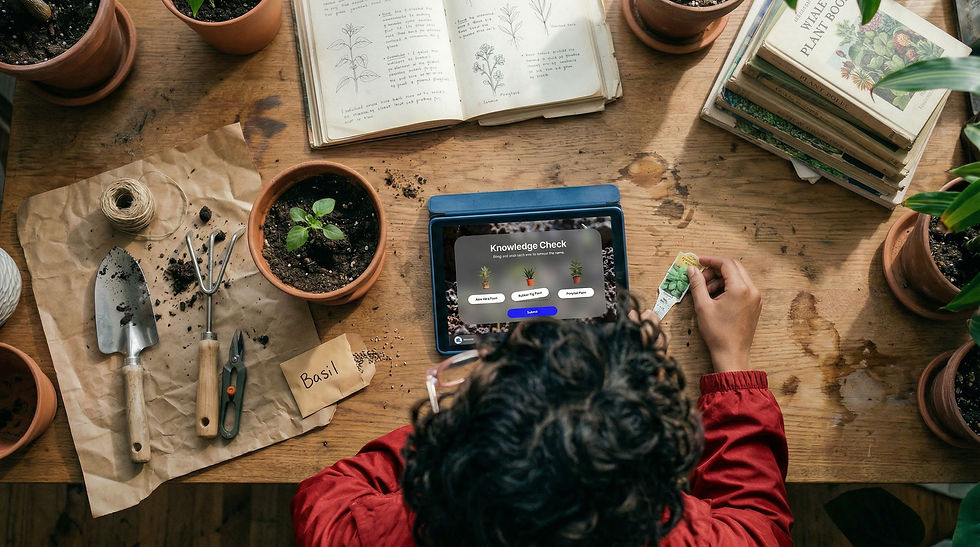
GlobeKin includes Kin, an AI-powered learning companion built specifically to support kids through the platform's science, nature, and engineering content.
Kin stays within the scope of GlobeKin's educational modules rather than functioning as an open-ended chatbot and works alongside a parent dashboard that gives families visibility into how their child is engaging with the platform.
FAQ: AI Tutor for Kids
Is it safe for kids to use an AI tutor? It can be, provided the tool is scoped to educational content, includes moderation beyond the base AI model, and gives parents visibility into how it is being used. Open-ended, unmoderated AI chatbots are a different risk category entirely.
What is the difference between an AI tutor and a general AI chatbot? An AI tutor built for kids is typically restricted to specific educational content and designed with age-appropriate guardrails, while a general chatbot has no such restrictions and was not built with children in mind.
Can an AI learning companion replace a real tutor or teacher? No, and it should not try to. It works best as a supplement for specific moments of curiosity or confusion, not a replacement for human instruction and connection.
AI in children's education is still a relatively new space, and not every product has been built with the same level of care. A few clear, direct questions are usually enough to tell the difference between a thoughtfully designed AI tutor for kids and one that simply followed a trend without the safeguards to back it up.



Comments